


Table of contents
Roughly 2 million construction workers in the U.S. are exposed to respirable crystalline silica on the job, which is a byproduct of drilling, cutting, and grinding concrete that OSHA now strictly regulates under its silica standard. That's just one of many reasons why using the right concrete tool isn't just about efficiency; it's about doing the job safely and staying compliant.
Concrete work spans a wide range of tasks: drilling anchor holes, breaking up slabs, cutting control joints, consolidating pours, fastening to concrete, and mixing materials. Each of those tasks has a purpose-built tool designed specifically for it.
This guide breaks down DeWalt's concrete tool lineup by category, explains what each type of tool is designed to do, and covers the specific models available so you can match the equipment to your work before you step on site.
DeWalt's Concrete Tool Platforms: 20V MAX, 60V FLEXVOLT, and Corded

Before getting into individual tools, it helps to understand where each product fits in DeWalt's system. DeWalt's concrete tools span three power configurations: the 20V MAX cordless platform, the 60V MAX FLEXVOLT cordless platform, and corded options for when you've got consistent power available.
The 20V MAX platform handles lighter concrete work well. Tools like the ATOMIC 20V MAX rotary hammer and the 20V MAX concrete vibrator are built for tasks where portability matters most and the application doesn't demand maximum power output. If you're already running a 20V MAX system on your truck, these tools slot right in without adding another battery to manage.
The 60V MAX FLEXVOLT platform is DeWalt's answer for heavy concrete work. The FLEXVOLT batteries deliver more power than 20V MAX, and the tools built around them, like the DCH614X2 rotary hammer, DCH892X1 chipping hammer, and DCS690X2 cut-off saw, are designed for sustained heavy use. If you're doing serious concrete work day in and day out, FLEXVOLT is the right investment.
Corded tools like the D25263K rotary hammer and D25872K demolition hammer are still in the DeWalt lineup for a good reason. They don't need a battery charge, they don't lose performance as the charge drops, and on job sites where you've always got power access, they're reliable all-day tools that don't need any babysitting.
DeWalt Rotary Hammers: The Right Tool for Drilling Into Concrete

If there's one tool that's built specifically for concrete drilling, it's the rotary hammer. A standard drill can push a masonry bit through concrete, but it's fighting the material the whole time. A rotary hammer uses a piston mechanism to deliver a hammering blow in the same direction the bit is spinning, so you're chipping into the concrete at the same time you're rotating through it. The result is faster holes, less bit wear, and less effort from the operator.
The key specs to understand are impact energy (measured in joules), blows per minute (BPM), and shank type. SDS Plus accepts bits with a smaller shank and handles holes up to about 1-1/8 inches in diameter. SDS Max uses a larger, more robust shank that's designed for heavier drilling and larger-diameter applications. DeWalt's rotary hammer lineup covers both, with 20V MAX, 60V MAX FLEXVOLT, and corded configurations.
Model |
Power |
SDS Type |
Impact Energy |
Key Feature(s) |
| DCH614X2 |
60V MAX FLEXVOL |
SDS Max |
10.5 J |
E-CLUTCH kickback protection, SHOCKS AVR, 1,450-2,900 BPM, 7-position variable speed |
|
DCH172E2 |
20V MAX ATOMIC |
SDS Plus |
N/A |
Compact and lightweight for overhead work, SHOCKS AVR, includes POWERSTACK battery |
|
D25263K |
15A Corded |
SDS Plus |
3.0 J |
D-handle grip, SHOCKS Active Vibration Control |
|
D25333KDH |
Corded |
SDS Plus |
N/A |
Integrated dust extractor attachment for OSHA silica compliance |
|
DCH966Z2 |
60V MAX FLEXVOLT |
SDS Plus |
N/A |
39.5" extended reach for deep-hole drilling applications |
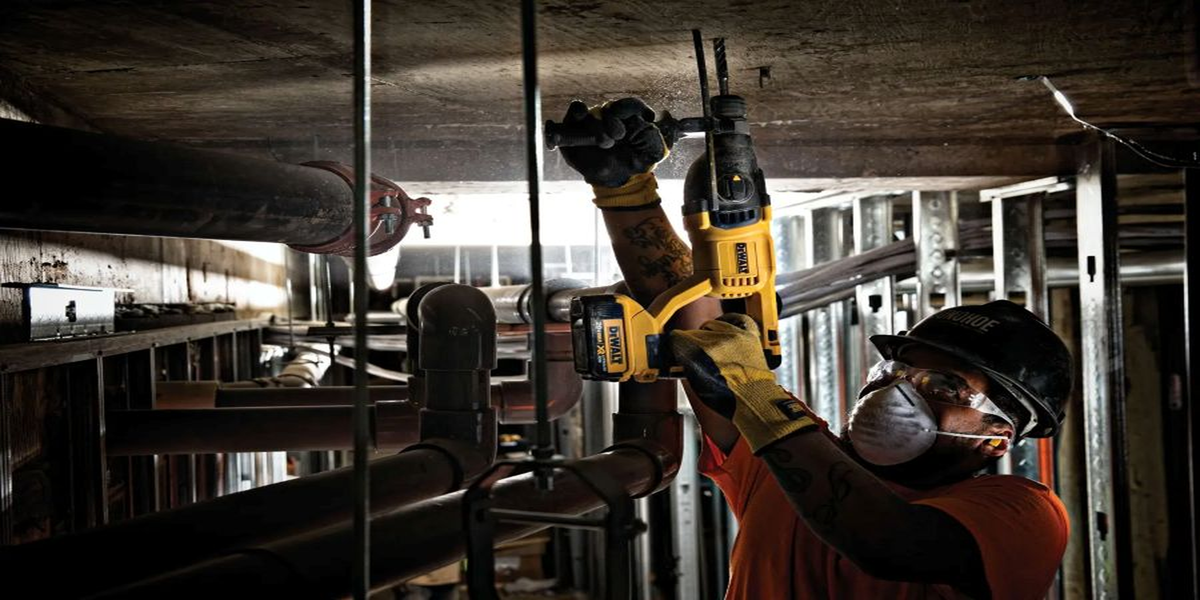
For light anchor work, installing Tapcons, or hanging a strut overhead, the DCH172E2 ATOMIC is the right pick. It's a compact 20V MAX tool that's light enough to run at shoulder height or above for extended periods without wearing you out. The SHOCKS Active Vibration Control system makes a real difference when you're doing overhead work for hours at a time, and the included POWERSTACK battery keeps the overall weight down.
For heavier anchor drilling or combination work where you're both drilling and chipping, the DCH614X2 handles it. Running on 60V MAX FLEXVOLT, it puts out 10.5 joules of impact energy and runs from 1,450 to 2,900 BPM with a brushless motor. The E-CLUTCH system stops bit rotation if the bit binds during drilling, which prevents the kind of wrist-wrenching kickback that happens with large-diameter holes in hard concrete.
The D25333KDH is worth considering if silica dust exposure is a concern on your job site. It pairs a 1-1/8 inch SDS Plus rotary hammer with an integrated dust extractor attachment that captures dust at the source while you drill. OSHA's silica rules apply to most construction operations, and having built-in dust collection is a practical way to stay compliant without setting up a separate vacuum system.
The DCH966Z2 is a specialty unit built for extended-depth drilling with a 39.5-inch reach. It's designed for applications where you need to drill deep into concrete or masonry from a single position, the kind of work where a standard-length rotary hammer can't get the depth you need without repositioning.
DeWalt Demolition and Chipping Hammers: Breaking Concrete the Right Way

A demolition hammer does one thing: break concrete. There's no rotation, just pure hammering action. That makes it the right tool for breaking up slabs, chipping tile off concrete floors, removing old masonry, and preparing concrete surfaces. If you're running a rotary hammer in chipping mode for extended demolition work, you're using the wrong tool for the job and you're wearing it out faster than it was designed for.
The difference between a chipping hammer and a demolition hammer mainly comes down to weight and impact energy. Lighter chipping hammers in the 15 to 22 pound range are suited for horizontal wall work and surface prep. Heavier units are built for floor and slab demolition. The higher the joule rating, the more energy is transferred to the chisel with each blow, and the faster the material breaks.
Model |
Power |
Weight |
Impact Energy |
Key Feature(s) |
| DCH892X1 | 60V MAX FLEXVOLT |
22 lbs. |
19.4 J |
SHOCKS AVR, Wireless Tool Control (links to dust extractor), 2,210 BPM, OSHA Table 1 compliant w/ DCV585 |
|
D25872K |
15A Corded |
19 lbs. |
13.3 J |
Constant-speed electronics, SHOCKS AVR, 1,350-2,705 BPM, horizontal and downward chipping |
The DCH892X1 is DeWalt's heavy cordless option in this category. At 22 pounds and 19.4 joules, it brings serious chipping power without a cord in the way. Running on 60V MAX FLEXVOLT with a 9.0Ah battery, it delivers up to 2,210 BPM. The WIRELESS TOOL CONTROL feature links it to a compatible DeWalt FLEXVOLT dust extractor so both the hammer and the vacuum activate and deactivate at the same time, which matters in enclosed spaces where silica exposure is a real concern. The tool is also TAG READY so you can track its location through the DeWalt Tool Connect app.
The D25872K is the corded option in the lineup, built for all-day sustained chipping. At 19 pounds and 13.3 joules of impact energy, it puts out between 1,350 and 2,705 BPM with constant-speed electronics that keep the tool's speed consistent under load. For day-long demolition work where you've got consistent power, a corded demo hammer means you're never stopping to swap batteries in the middle of a run.
DeWalt Concrete Cut-Off Saws: Cutting Slabs, Joints, and Rebar

Concrete cut-off saws handle a different category of work than hammers and drills. These are the right tools for cutting control joints in slabs, scoring concrete surfaces, cutting pave stones to fit, trimming CMU block, and cutting through rebar or steel. Before cordless options were viable, this work required either a gas-powered saw or a corded electric saw with an extension running back to a power source.
Model |
Power |
Wheel |
Max Depth |
Key Feature(s) |
| DCS690X2 |
60V MAX FLEXVOLT |
9 in. |
3-1/4 in. |
6,600 no-load RPM, wet/dry cutting, includes ceramic metal and diamond cutting wheels, 2x 9.0Ah batteries in kit |
The DCS690X2 runs on DeWalt's 60V MAX FLEXVOLT platform and spins a 9 inch wheel at up to 6,600 no-load RPM. That translates to cuts up to 3-1/4 inches deep in a single pass, which covers most concrete cutting tasks in residential and light commercial work. The kit includes two 9.0Ah FLEXVOLT batteries, a ceramic metal cut-off wheel for steel and metal, and a diamond cutting wheel for concrete, pavers, and masonry, so you're set up for multiple materials right out of the box.
The biggest advantage of a cordless cut-off saw is access. When you're cutting control joints across a large slab or working on elevated structures where running a cord is a hassle, not having to manage a cord or deal with a gas engine makes a real difference in how fast you can move. The DCS690X2 also supports wet cutting when you add water, which helps control dust and extends wheel life on harder materials.
DeWalt Concrete Vibrators: Eliminating Air Voids in Poured Concrete

Concrete vibrators don't get as much attention as rotary hammers or demo tools, but if you're placing concrete, a vibrator is one of the most important tools you've got on the job. When you pour concrete, air bubbles get trapped in the mix during placement. If those bubbles stay in the finished pour, you end up with voids, honeycombing, and structurally compromised concrete. A vibrator is inserted into the wet concrete at regular intervals and the vibration consolidates the mix, pushing the air to the surface.
The pencil vibrator format, also called an immersion vibrator, is the most common type for residential and light commercial work. You insert the vibrating head into the pour at regular intervals across the formwork, let it run for a few seconds at each location, then pull it slowly upward before moving to the next spot. Done right, it produces a denser, stronger pour with better surface quality.
Model |
Power |
Style |
Notes |
| DCE531B |
20V MAX |
Pencil / Immersion |
Bare tool — pairs with any 20V MAX battery. Cordless convenience for footings, walls, and slab pours |
The DCE531B runs on DeWalt's 20V MAX platform, which means if you're already running 20V MAX tools on site, it draws from the same batteries you've got on your belt. It's a bare tool, so you'll pair it with a 20V MAX battery you already own. For poured footings, wall forms, and slab placements, it gives you the cordless convenience of being able to move freely around the pour without dragging an extension cord back to a generator.
DeWalt Concrete Nailers: Fastening to Concrete Without Powder Loads

Before cordless electric concrete nailers, you had two main options for fastening to concrete: a powder-actuated nailer or drilling and setting concrete anchors. Powder-actuated tools are fast, but they require powder loads that you've got to track and stock, and the report from each shot requires hearing protection even outdoors. Concrete anchor installation is reliable but slow when you've got a lot of fastening to do.
DeWalt's cordless concrete nailer uses electric combustion to drive hardened fasteners directly into concrete and steel. It runs on a standard 20V MAX battery, needs no powder loads, and works without a compressor or gas cartridges.
Model |
Power |
Fastener Range |
Shots/Charge |
Key Feature(s) |
| DCN890P2 |
20V MAX XR |
1/2" to 2-1/4" |
Up to 600 |
3 adjustable power settings for hollow block, hard concrete, and steel. Kit includes 2x 5.0Ah batteries, drywall contact trip, charger |
The DCN890P2 drives fasteners from 1/2 inch to 2-1/4 inches and has three adjustable power settings so you can tune the tool for what you're nailing into, whether that's hollow block, hard concrete, or steel. With a DCB205 5.0Ah battery, you're looking at up to 600 shots per charge, which is enough to handle a serious production day. The kit includes two batteries, a drywall contact trip for working in finished areas, and a charger.
For electricians attaching conduit supports to concrete, framers anchoring bottom plates to slab, or contractors fastening furring strips to concrete block walls, this tool takes real time out of the process. You're not setting up a powder-actuated tool, loading charges, or running anchors. It's load the battery, set your power level, and go.
DeWalt Mixer/Drills: Mixing Concrete, Mortar, and Thinset on the Job Site

Mixing mortar, thinset, grout, and fiber-reinforced concrete by hand is slow work and it's hard on your body over the course of a day. A dedicated mixer drill makes the job faster and produces a more consistent mix. These aren't the same as a standard drill. They're built specifically for lower RPM and higher torque to handle the resistance of dense mixing materials without binding up or kicking back.
Model |
Power |
RPM |
Weight |
Key Feature(s) |
| DCD130B | 60V MAX FLEXVOLT | 0-600 RPM | 6.94 lbs. | E-Clutch anti-bind protection, mixes 9 buckets concrete, 17 buckets tile mortar per charge (DCB606 6.0Ah battery) |
The DCD130B runs on DeWalt's 60V MAX FLEXVOLT platform and turns at up to 600 RPM. The E-Clutch system cuts the motor if the mixing paddle binds, which protects both the tool and your wrists from sudden kickback. Per DeWalt's published specs, a single DCB606 6.0Ah FLEXVOLT battery gets through 9 buckets of concrete mix (4.5 gal), 17 buckets of tile mortar (5 gal), or 19 buckets of drywall compound (4.5 gal) per charge. It comes as a bare tool, so you'll add a FLEXVOLT battery and charger if you don't already have them.
For tile setters, finish masons, and contractors who mix materials regularly, the DCD130B handles the work better than a standard drill with a mixing attachment. It's purpose-built for the task, and the E-Clutch alone is worth it if you've ever had a mixing paddle lock up and wrench a drill out of your hands mid-mix.
How to Choose the Right DeWalt Concrete Tool for Your Work
A few questions narrow down the right choice fairly quickly.
First, what are you actually doing? Drilling holes requires a rotary hammer. Breaking concrete requires a demo or chipping hammer. Cutting through concrete or rebar requires a cut-off saw. Consolidating a pour requires a vibrator. Fastening to concrete or steel requires a nailer. These tools aren't interchangeable, and using the wrong one makes your job harder and puts unnecessary wear on the tool.
Second, what's your battery situation? If you're running a 20V MAX kit, the DCH172E2 rotary hammer, DCE531B vibrator, and DCN890P2 nailer all pull from that same platform. If you're doing heavier work or you're building out a FLEXVOLT setup, the 60V MAX tools, including the DCH614X2, DCH892X1, and DCS690X2, are built for it. The batteries work across the platform, so starting with one 60V MAX tool doesn't lock you into a separate system.
Third, do you have consistent power access on site? If the answer is yes, DeWalt's corded options like the D25263K rotary hammer and D25872K demo hammer are reliable, all-day tools that don't require any battery management. If you're moving around a large site or working in areas where pulling power is a hassle, cordless makes more sense even if you're doing heavier work.
It's also worth thinking about vibration exposure if you're running hammers and chipping tools for extended periods every day. All of the DeWalt rotary hammers and demo hammers covered in this guide include SHOCKS Active Vibration Control, which uses a spring-loaded mechanism to reduce the vibration transmitted to the handles. Over the course of a long day with a chipping hammer, that makes a real difference in how your hands and arms feel at quitting time.
Final Thoughts
DeWalt's concrete tool lineup covers the full range of what tradespeople run into on the job site. Whether you're drilling anchor holes on a commercial build, breaking up a residential concrete floor, cutting control joints in a new slab, vibrating a footing pour, or mixing mortar for a masonry repair, there's a purpose-built DeWalt tool for the application.
The key is matching the tool to the task. A 60V MAX FLEXVOLT rotary hammer is a great investment if you're drilling anchors every day, but it's overkill for the occasional light masonry job. A cordless chipping hammer makes sense when you're working in areas without power access, but the corded demo hammer is the right choice for all-day sustained demolition where you've got consistent power.
All of the DeWalt concrete tools covered in this guide are available at Authorized Tool Outlet. If you've got questions about which model fits your work, reach out and the team can help you narrow it down.
Frequently Asked Questions About DeWalt Concrete Tools
What's the difference between a rotary hammer and a demolition hammer?
A rotary hammer both spins and hammers, which makes it the right tool for drilling holes in concrete and masonry. A demolition hammer only hammers — no rotation — so it's built purely for breaking and chipping. Using a rotary hammer for extended demolition work puts extra wear on the piston mechanism because it's doing more than it's designed for. For any serious concrete breaking work, use a dedicated demo or chipping hammer.
What DeWalt voltage platform is best for heavy concrete work?
For heavy concrete work, DeWalt's 60V MAX FLEXVOLT system is the better fit. The higher voltage delivers more sustained power, and tools like the DCH614X2 rotary hammer, DCH892X1 chipping hammer, and DCS690X2 cut-off saw are specifically engineered around that platform. For lighter applications like overhead anchor drilling, installing fasteners, or small pours, the 20V MAX platform works well and keeps the tool weight down.
What's the difference between SDS Plus and SDS Max?
SDS Plus uses a smaller shank diameter and is designed for bits up to about 1-1/8 inches. It's the right system for anchor drilling, general masonry work, and moderate applications. SDS Max uses a larger, more robust shank that handles larger-diameter bits and heavier drilling or chipping tasks. Most heavy-duty rotary hammers and all dedicated chipping hammers use SDS Max. If you're shopping for bits and accessories, make sure you're matching the shank type to your tool.
Do I need a concrete vibrator on smaller residential pours?
For anything structural — footings, foundation walls, slabs, columns — using a vibrator is worth it. Voids and honeycombing can happen in any pour where the concrete mix doesn't fully consolidate around rebar and into the corners of the form. On smaller residential jobs, a cordless pencil vibrator like the DCE531B is compact enough to keep on the truck and easy to deploy on a footing pour without setting up a generator or extension cord.
Can the DeWalt cordless cut-off saw handle wet cutting?
Yes. The DCS690X2 supports both wet and dry cutting. The kit includes a diamond cutting wheel that's designed for wet cutting applications. Wet cutting helps manage silica dust at the source and keeps the wheel cooler, which extends its life on harder materials like concrete and natural stone.
Is the DeWalt cordless concrete nailer worth it compared to a powder-actuated tool?
For contractors who fasten to concrete regularly, the DCN890P2 removes a lot of the overhead that comes with powder-actuated tools. There are no loads to track, no special licensing in jurisdictions that require it for powder tools, and no waiting on restocking powder cartridges. The three adjustable power settings let you tune the tool for different substrates, and the shot count per charge is solid for production use. The main advantage of powder tools is that they don't need a battery charged and ready — if you're doing occasional spot fastening, that's worth considering.


